Japanese textbook review #1
I mentioned that I'm intending to create a page for Japanese language studies, recommending textbooks, websites, etc soon if there is time, but I decided to make little review posts.
In this posts I will describe various textbooks, software CDs, online flash cards, websites, etc of Japanese language studies and make a personal final conclusion.
I will post about the textbooks, websites, etc. I used otherwise it would be nonsense to make a personal conclusion without using the material.
Most Japanese language materials I used were in German language, but most of them are the same in other languages as well. Maybe there are some textbooks, which aren't available in English, but I will research if there are other versions available on the internet, like amazon.
My first review is about a Japanese textbook series, which is available in several languages. Some of you may know it or at least heard about it.
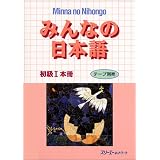 |
Minna no Nihongo (みんなの日本語) is a textbook series consisting of a Japanese textbook, a Japanese workbook, translations & grammar explanations in several languages (Chinese, Korean, English, German, Spanish, etc.), Kanji books and other more or less useful books. Actually you don't need the Kanji book and Kanji workbook, because there are a lot of better ways to study Japanese Kanji. [personal tip]
The version of Minna no Nihongo (みんなの日本語) I used was in German even if I didn't think it is available on German, before, because I haven't seen it in German language in a book store or the internet.
There are also different levels of this book. Beginner, intermediate, advanced skill level textbooks are available. The one I used was the beginner version, but I already studied Japanese before using this book, so I didn't had any problems. But for real beginners without any knowledge or only a small knowledge of the Japanese language I don't recommend to start with this book, because its textbook and workbook are completely written in Japanese. Only start using this book if you're able to read and write Hirgana & Katakana. [personal tip] There are a few Kanji, but don't worry about them since there are Furigana always with the Kanji transforming them into Hiragana, for the ones who didn't know what Furigana means.
There is a complete translation of the textbook, but it is useless if you're studying Japanese by translations without knowing how to read or write a sentence or even a word.
So far about its skill level.
Minna no Nihongo (みんなの日本語) offers a lot of vocabulary with each lesson and each text or dialog showing new situations and new grammar. The vocabulary is noted down in Kanji - Furigana - Translation into your book's language, so it's pretty good for studying, because you can study the Kanji with each word meaning if you'd like to. When I started studying Japanese I didn't learn my vocabulary with Kanji only Katakana/Hiragana and its translation, because it's more easy and faster for a beginners than starting studying Kanji at the beginning. [personal tip]
So far about the vocabulary and words used in this textbook.
The grammar starts with very simple things like how to create a sentence in Japanese, explaining the particles main functions, how to create a question, etc and ends up in indirect speech, conditional, the difference between give-receive-send in Japanese. as~, etc. The grammar explanations are very useful for beginners, because of its example, descriptions and easiness, but also for people, who just want to refresh their language skills or have to look up something.
Minna no Nihongo (みんなの日本語) workbook is like the textbook not perfect for total beginners, because it's in Japanese-only, but if you're able to read and write Hiragana and Katakana it shouldn't be a problem, because the vocabulary is the same like in the textbook and each exercise consists of at least one example.
The design of the textbook isn't very attractive since there is just text mixed up with a few strange b/w pictures and sketches, but for a seriously language studying this isn't needed that much. Sometimes the sketches are very helpful for understanding a specific difference, which maybe doesn't exist in the English or in my case in the German language - and believe me are a lot of those things, which you just can't translate one-to-one into English or German. But by reading a good description, explanation or a useful sketch you're able to understand and to use it.
final conclusion of Minna no Nihongo (みんなの日本語)
If you're already able to read and maybe write Hiragana and Katakana - or at least Hiragana, the Katakana aren't used that often so you can look them up - I recommend this book. If you have basic knowledge of Japanese language and want to break this limit between beginner/basic and intermediate this book is really useful, because of its topic-based vocabulary, texts and because of it's various grammar explanations, which will help you to improve your Japanese skills in understanding, but also in using the Japanese language.





Awesome review ! :)
I can't remember the first book I used .. I think it was called "Bento" or something hehe. But yes~ WAY WAY WAYYY back when I first started learning Japanese ( 13 years old ) I only knew how to read Hiragana / Katakana and the very few Kanji. But now at my level ..I wish everything was just in Hiragana *-* Kanji is so hard for me >.<
Same here. If the Kanji didn't exist, Japanese wouldn't be any problem at all. Or just less Kanji, but they're just too much T__T
Minna no Nihongo habe ich auch. =D aber das hellgrüne mit den Punkten. xD
cool, dass du dir die Mühe gemacht hast. :D